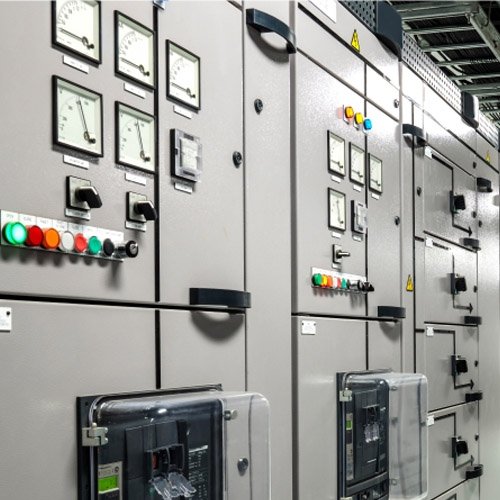
Electrical distribution and control systems need more than a metal enclosure filled with switching devices. A properly engineered panel has to manage electrical loads safely, provide dependable protection, allow practical maintenance, and remain suitable for the operating conditions of the installation.
Atlanture Transformer & Switchgear Pvt. Ltd. develops LV control panel assemblies for industrial, commercial, infrastructure, utility, and project-based electrical installations. The approach combines electrical design, enclosure fabrication, component integration, wiring, inspection, and testing into one controlled manufacturing process. As a premier LV Control Panel manufacturer in India, our objective is straightforward: deliver a panel that fits the electrical system it is being installed into rather than forcing the project to adapt around a standard cabinet.
A control and distribution assembly is normally designed after understanding the characteristics of the complete installation. Incoming supply, connected loads, fault levels, feeder requirements, operating conditions, available installation space, cable entry arrangement, and future expansion can all influence the final configuration.
Depending on the application, an LV Control Panel in India may incorporate incoming and outgoing switching devices, protective equipment, metering, indication, control circuits, busbar systems, terminal arrangements, and auxiliary components.
The engineering stage is therefore important because component selection cannot be separated from the overall electrical architecture.
A practical design considers:
This project-specific approach helps create equipment that is technically appropriate for its intended duty.
The physical construction of a panel has a direct effect on its serviceability and operating life. As a dedicated LV Control Panel manufacturer in India, our enclosure fabrication begins with dimensional planning and selection of suitable sheet-metal construction according to the required mechanical strength, mounting arrangement, access requirements, and installation environment.
Fabricated sections are prepared with attention to dimensional accuracy, door alignment, mounting provisions, cable entry, component clearances, and internal accessibility. The enclosure is then prepared for finishing and component assembly.
Inside the panel, the arrangement of electrical equipment is planned to maintain practical separation, provide clean cable routing, and leave sufficient working space for inspection and servicing.
Busbars are fabricated and positioned according to the electrical design. Their sizing and arrangement are important because the busbar system must accommodate the expected current while maintaining suitable clearances and mechanical support.
Internal wiring is routed systematically rather than simply packed into the available space. Proper identification, termination, ferruling, dressing, and support make future troubleshooting significantly easier.
The result should be an assembly that is not only electrically functional but also understandable to the maintenance team that will operate it years after installation.
The panel configuration can be developed around the requirements of the individual project.
Key features may include:
The exact combination of equipment depends on the electrical design, project specifications, selected components, and operating conditions.
The principal role of an electrical panel is not simply to distribute power. It must also help protect people, equipment, cables, and downstream circuits when abnormal conditions occur.
Protection devices are selected according to the characteristics of the connected system. Depending on the application, this can involve protection against overloads, short circuits, earth faults, or other electrical abnormalities.
The coordination of protective devices is particularly important in larger installations. A fault on one outgoing circuit should ideally be isolated by the appropriate protective device without unnecessarily interrupting unrelated feeders.
For this reason, protection settings and equipment selection should be considered as part of the complete electrical design rather than treated as an afterthought.
Because these assemblies are project-engineered, the final specification is established from the approved electrical drawings and application requirements.
Typical specification parameters include:
|
Parameter |
Project-Dependent Configuration |
|
System |
Low-voltage electrical distribution and control |
|
Construction |
Floor-mounted, wall-mounted, or application-specific |
|
Enclosure |
Fabricated sheet-metal construction |
|
Incoming arrangement |
Selected according to supply design |
|
Outgoing feeders |
Configured according to connected loads |
|
Busbar material |
Copper or aluminium, as specified |
|
Protection |
Selected according to load and fault requirements |
|
Metering |
Digital or conventional instruments as required |
|
Control circuits |
Designed according to operational requirements |
|
Cable entry |
Top, bottom, or project-specific |
|
Internal wiring |
Identified and systematically arranged |
|
Finish |
Industrial-grade surface treatment as specified |
|
Dimensions |
Based on equipment and installation requirements |
|
Accessibility |
Designed for inspection and maintenance |
Final ratings, component brands, fault withstand capability, enclosure dimensions, degree of protection, and other parameters should always be confirmed against the approved project documentation before manufacturing.
A correctly engineered assembly from a trusted LV Control Panel supplier in India can provide several practical advantages throughout the operating life of an electrical installation.
Better Operational Control
Switching, indication, metering, and control equipment can be brought together in an organized arrangement, giving operators a clear interface with the electrical system.
Improved Maintenance Access
Logical component placement and organized internal wiring make inspection and troubleshooting more efficient. Maintenance personnel can identify circuits and connections without working through an unnecessarily congested assembly.
Protection of Connected Equipment
Appropriately selected protective equipment helps limit the impact of electrical faults and abnormal operating conditions on downstream circuits.
Application-Specific Construction
The enclosure, feeder arrangement, component selection, and internal configuration can be developed around the actual project instead of relying on an unsuitable standard arrangement.
Easier Project Integration
A properly documented and fabricated assembly can be integrated into a larger electrical distribution system with clearer interfaces between incoming supply, feeders, control circuits, and connected equipment.
LV control and distribution assemblies can be used across a wide range of electrical installations, including:
The internal configuration changes significantly between applications. A manufacturing plant with multiple motor feeders, for example, may require a substantially different arrangement from a commercial building where distribution and metering are the primary requirements.
Quality control should continue from fabrication through final assembly.
Typical inspection activities can include verification of enclosure dimensions, component mounting, busbar installation, tightening of electrical connections, wiring identification, terminal arrangements, protective-device configuration, and general workmanship.
Electrical checks may include continuity verification, insulation-related checks, functional verification of control circuits, and inspection of the completed assembly against approved drawings and specifications.
The purpose of final inspection is not merely to confirm that the panel looks complete. It is to identify assembly errors before the equipment reaches the project site, where corrections can become more disruptive and expensive.
Every electrical project has its own combination of load characteristics, installation conditions, space restrictions, operating procedures, and future requirements.
As an experienced LV Control Panel supplier in India, Atlanture Transformer & Switchgear Pvt. Ltd. works from project information to develop the appropriate panel configuration for the intended application. The manufacturing capability covers the enclosure, internal arrangement, electrical integration, wiring, inspection, and preparation for installation.
For project teams, EPC contractors, electrical consultants, industrial users, infrastructure developers, and facility operators, this engineering-led approach provides a more practical route to obtaining an LV Control Panel in India that matches the wider electrical system.
A reliable panel is the result of disciplined engineering and manufacturing rather than simply selecting individual electrical components.
As a leading LV Control Panel distributor in India, Atlanture Transformer & Switchgear combines electrical equipment manufacturing with practical experience in transformer-related engineering, testing, commissioning, maintenance, and field support. This broader understanding helps connect panel requirements with the realities of electrical installations.
Key advantages include:
The right configuration starts with the right project information.
Share your single-line diagram, load details, incoming supply information, feeder schedule, installation dimensions, protection requirements, and any applicable project specifications with the engineering team. These details allow the proposed assembly to be developed around the actual electrical duty.
For a new installation, plant expansion, system replacement, or electrical upgrade, discuss the application with Atlanture Transformer & Switchgear, a trusted LV Control Panel distributor in India, and develop an LV Control Panel in India suited to the project's technical and operational requirements.
Contact Us
Feel Free To Get In Touch With Us
Office Address:
Plot no F-24 Ramnagar Industrial Area Phase -II Varanasi, Uttar Pradesh- 232104 India.
Follow Us:-