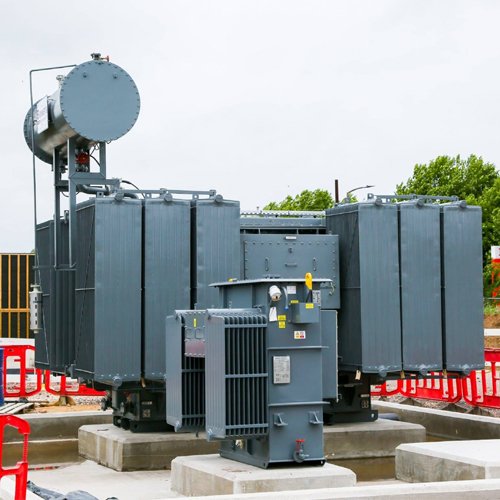
Reliable electrical distribution depends on equipment that can operate continuously, manage changing loads, withstand demanding site conditions, and maintain predictable electrical performance over its service life. A distribution transformer is therefore not simply a voltage-conversion device; it is a critical part of the electrical infrastructure connecting incoming supply with the loads that depend on it. For facilities seeking a dependable Distribution Transformer in Varanasi, selecting a solution built to high technical standards is vital for uninterrupted operations.
Atlanture Transformer & Switchgear Pvt. Ltd. develops transformer solutions for industrial facilities, commercial infrastructure, utility networks, institutional projects, and other applications where dependable power delivery is essential. As an established Distribution Transformer Manufacturer in Varanasi, our approach—from engineering and material selection to winding, assembly, inspection, and final testing—is focused on electrical performance, mechanical integrity, safety, and long-term serviceability.
Transformer selection should begin with the electrical duty rather than simply choosing a standard rating. Connected load, anticipated demand, voltage levels, installation environment, operating temperature, duty cycle, future expansion, and available space can all influence the appropriate design.
The engineering process considers these factors before the unit is finalized. This helps prevent common procurement problems such as inadequate capacity, excessive losses, unsuitable dimensions, poor thermal margins, or an installation arrangement that becomes difficult to maintain.
For industrial and infrastructure buyers working with an experienced Distribution Transformer Supplier in Varanasi, this approach provides a more practical balance between initial investment, operating efficiency, reliability, and lifecycle requirements.
A dependable transformer begins with controlled manufacturing rather than final-stage testing alone. The magnetic core, windings, insulation system, tank, cooling arrangement, terminals, and accessories must work together as one electrical and mechanical system.
The magnetic core forms the path through which alternating magnetic flux is established. Careful processing and assembly of electrical steel help control magnetic losses and operating noise while maintaining the intended magnetic characteristics.
Core joints, clamping, alignment, and mechanical support are important because imperfections in these areas can contribute to additional losses, vibration, or unwanted heating.
The winding system must withstand both normal operating stresses and abnormal electrical conditions. Conductor selection, insulation, winding geometry, mechanical support, clearances, and connections are therefore treated as engineering considerations rather than isolated manufacturing steps.
Proper winding construction also contributes to thermal performance because heat generated during operation must be transferred effectively into the surrounding insulation and cooling medium.
Electrical insulation separates conductors operating at different potentials and provides the necessary dielectric strength throughout the active portion of the unit.
Insulating materials, clearances, barriers, leads, connections, and internal supports are assembled with attention to electrical stress and mechanical stability. Good workmanship at this stage is essential because defects that are difficult to detect visually can later become reliability problems.
The enclosure provides mechanical protection for the active assembly and contains the insulating medium where applicable. Fabrication quality is important for dimensional accuracy, structural strength, sealing, and resistance to environmental exposure.
Associated fittings and accessories are selected according to the design and application, with consideration given to safe operation, inspection, maintenance, and connection requirements.
These transformer solutions can be integrated into a wide range of electrical infrastructure, including:
The appropriate configuration depends on the electrical characteristics and operating conditions of each installation.
|
Parameter |
Engineering Consideration |
|
Rated capacity |
Selected according to connected and anticipated load |
|
Phase arrangement |
Determined by the electrical system and application |
|
Primary voltage |
Based on incoming supply requirements |
|
Secondary voltage |
Selected according to downstream distribution requirements |
|
Frequency |
Designed for the applicable power-system frequency |
|
Cooling |
Selected according to capacity, duty, and thermal requirements |
|
Insulation system |
Determined by voltage level and operating conditions |
|
Conductor material |
Selected according to electrical and thermal design |
|
Core construction |
Designed to control magnetic losses and support efficient operation |
|
Installation |
Configuration considered according to site conditions |
|
Testing |
Electrical and performance checks completed before dispatch |
Final technical values should always be established against the approved project specification, electrical design, applicable standards, and site requirements rather than assumed from a generic product description.
Testing is one of the most important stages before electrical equipment is released for installation. Atlanture Transformer subjects manufactured units to inspection and testing intended to identify electrical or construction-related issues before dispatch.
The testing scope includes checks such as:
These checks provide useful evidence that the completed unit corresponds with its intended electrical and thermal characteristics. For procurement teams relying on a trusted Distribution Transformer Distributor in Varanasi, factory verification reduces the risk of discovering avoidable problems only after equipment reaches the project site.
Quality control should not be viewed as a single final inspection. Material quality, workmanship, dimensional accuracy, winding integrity, assembly, connections, and testing all contribute to the final result.
For a transformer project, product selection is only one part of the procurement decision. The technical capability behind the equipment, responsiveness during engineering, testing discipline, and ability to support the equipment after delivery can have an equally important effect on project success.
Atlanture Transformer & Switchgear Pvt. Ltd. operates from Varanasi and provides electrical engineering as a premier Distribution Transformer Manufacturer in Varanasi, offering extensive manufacturing and service capabilities. Its wider technical offering includes erection, testing, commissioning, maintenance, breakdown support, repair, and overhauling services.
Working with a verified Distribution Transformer Supplier in Varanasi and Distribution Transformer Distributor in Varanasi provides continuity between equipment supply and field-level technical requirements.
The right transformer should provide more than a nameplate rating. It should be engineered around the electrical system, manufactured with controlled processes, tested before dispatch, and supported with practical technical understanding.
For projects requiring a Distribution Transformer in Varanasi, particularly across Uttar Pradesh and surrounding regions, Atlanture Transformer provides a project-oriented approach to transformer requirements, helping electrical consultants, EPC contractors, industrial buyers, infrastructure developers, and procurement teams evaluate equipment according to actual operating conditions.
Share the required capacity, voltage levels, phase arrangement, installation conditions, application, and project requirements with the technical team to specify the right Distribution Transformer in Varanasi. The engineering team can review the duty and help determine an appropriate configuration for the intended electrical system.
Contact Us
Feel Free To Get In Touch With Us
Office Address:
Plot no F-24 Ramnagar Industrial Area Phase -II Varanasi, Uttar Pradesh- 232104 India.
Follow Us:-